- Home
-
Private banking
-
LGT career

Can more data really lead to better hiring? Not always. In recruitment, data-driven decision-making has its limits, because when it comes to core human qualities, even the most sophisticated AI systems have blind spots. Conversations with HR professionals, software providers and academics reveal a consistent theme: in the age of algorithms and deepfakes, genuine personal interaction still matters.
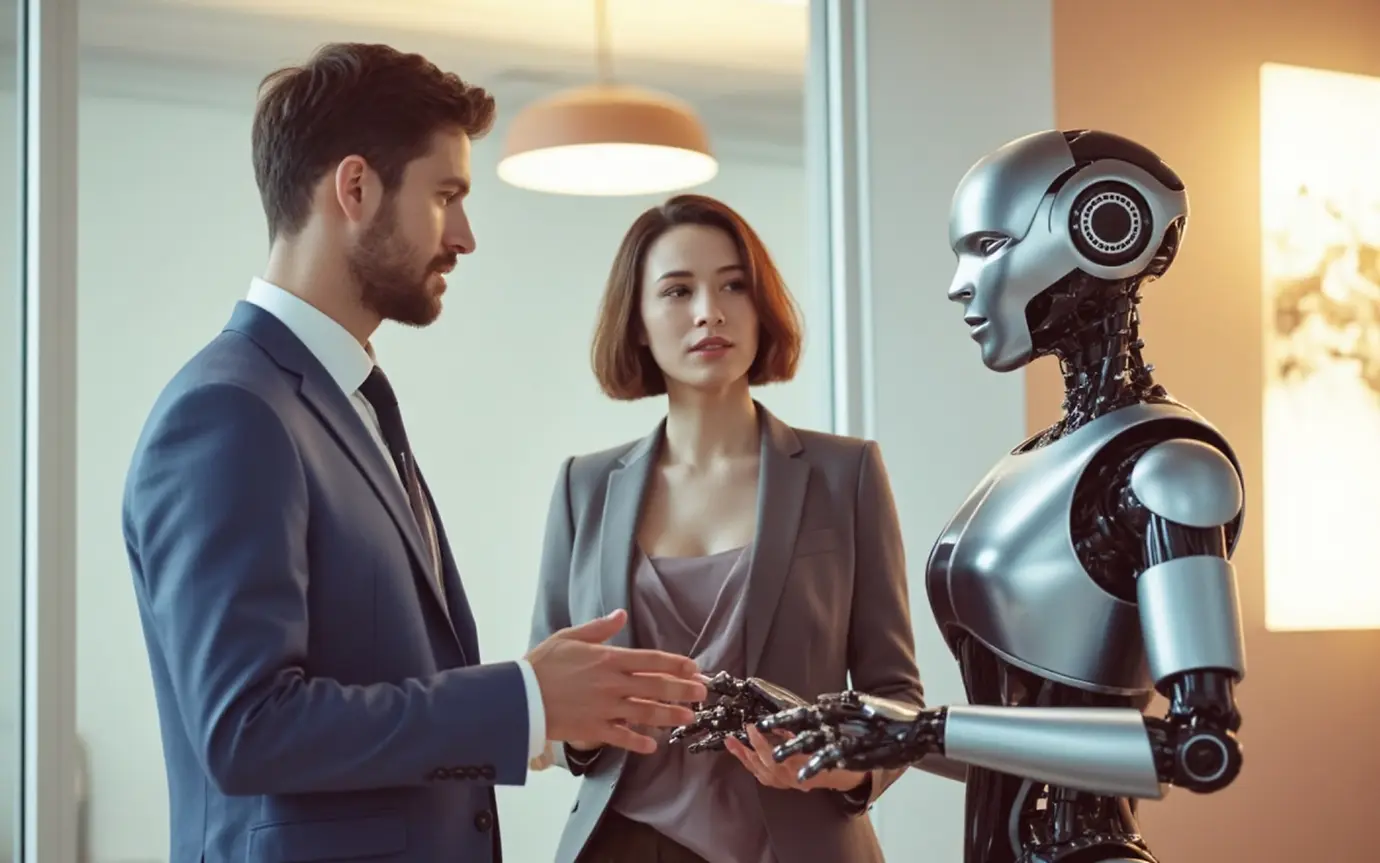
"May I ask you a personal question?"
The line is delivered by Rachael, the striking assistant to the CEO of a robotics firm, in the 1982 cult classic "Blade Runner". She looks and sounds entirely human - but she's not. Rachael is a replicant, a machine programmed to pass as a person. For now, that kind of scenario remains firmly in the realm of science fiction. But in the real world, data-driven systems powered by artificial intelligence (AI) are rapidly making inroads in the corporate world - even in areas that have traditionally relied heavily on human interaction. This development is transforming entire processes, for example, in human resources.
Today, AI tools write and publish job adverts, review CVs, comb through online profiles and even chat with candidates on social media. Behind the scenes, virtual assistants help shortlist applicants and create digital personnel files.

"In the war for talent, speed is key. With our AI tools, we're able to reach applicants more quickly, target them more specifically, and ultimately, create a better applicant experience", says Vicky Rittinghaus, Head of Human Resources at a mid-sized, international medical technology firm in Germany.
By automating time-consuming tasks, she adds, data-driven systems allow HR professionals to focus more on meaningful interactions with candidates.
"Our tools cut the time it takes our clients to successfully fill a vacancy by half", says Carolin Jahn, Senior B2B Marketing Manager at recruitment software firm Softgarden.
Despite the potential, many companies are still in the early stages of adoption. "In our industry, data security and compliance are top priorities, so we take a cautious approach to using data-driven HR tools", says the head of HR at the Dubai branch of a global infrastructure provider.
This view is echoed by the head of HR at a renowned research institute: "Our employees are some of the brightest minds. They're typically highly motivated and are looking for an environment where they have a lot of freedom to pursue their projects. That's why we place such importance on having an open dialogue among equals."
A survey of 300 companies conducted by the German Association for Human Resource Management (DGFP) found that around a third of companies are already using AI in HR. Other studies, such as one by the German digital association Bitkom (2024) and the Haufe HR Service Experience Study 2024 report slightly lower figures - but expect a clear upwards trend.


"On average, there are just 1.4 HR specialists for every 100 employees - even as their responsibilities grow increasingly complex", says Herman Aguinis, Professor of Management at the George Washington University School of Business. "Under those conditions, overwork and burnout are inevitable", he adds.
Aguinis sees tools like ChatGPT as useful support - with one important caveat: "Data-driven systems are a tool, not a silver bullet. They can inform decisions, but they shouldn't make them." Ideally, these tools can free up time for HR professionals to focus on strategic priorities - and in doing so, elevate their own roles.

More than half of executives say they are concerned about talent shortages at their company, and around two-thirds doubt their organisation has the skills needed to succeed in tomorrow's market. According to the latest Global State of Skills report by Workday, a cloud-based provider of HR and finance solutions, 55 % of companies are responding to these concerns by moving away from traditional hierarchies in favour of skills-based structures.
"Our study found that HR departments want to make greater use of AI to identify skills gaps, improve recruitment and support employee development", says Richard Doherty, Senior Director Product Marketing at Workday.
Unlike humans, AI systems focus on rational criteria. Emotions play no role in its decision-making. And many applicants actually appreciate this impartiality - up to a point. "If an AI gives a positive recommendation, six out of ten applicants are fine with that", says Carolin Jahn, citing a study by Softgarden "But if the hiring decision is made by AI alone, seven out of ten applicants object." The takeaway? Employers should be transparent about how they use AI.
Herbert Alexander Simon, a Nobel laureate and early AI pioneer, warned in the 1970s that an excess of information would lead to a shortage of attention. Or put differently, that too much information means risking losing sight of the forest for the trees. This concern feels especially relevant in HR, where digital dashboards and automated assessments abound.
But all respondents agree on one point: AI tools are only as good as the data they are fed. In some cases, this means the recruitment process can degenerate into a contest between machines, with AI-generated CVs vying to score points with corporate algorithms. What those algorithms struggle with, however, is evaluating personal characteristics and how they fit with a company's corporate culture.


"If we're saving time by using efficient tools, we need to use that time to focus on qualities that can't be quantified, like social skills, adaptability and leadership potential", says Vicky Rittinghaus. In other words, the qualities that matter most in international leadership roles.
Rittinghaus is convinced that HR managers will need to place even greater emphasis on personal interaction in the future. "We have to take a personal approach if we want to build relationships with candidates and show them that they're truly valued", she says.
Doherty and Jahn agree; they believe that AI should support - not replace - the human touch in HR.
Mathias Binswanger, Professor of Economics at the University of Applied Sciences and Arts Northwestern Switzerland, is even more sceptical of AI. He argues that more data inevitably leads to more systems designed to manage it. The result? Layer upon layer of bureaucratic controls and "pseudo-precision" that provides few additional insights.

This, Binswanger warns, can also lead to flawed decisions. "You can write an application in a way that is tailored to score well with a specific AI - but many human qualities only emerge in conversation. Is someone authentic? How do they think on their feet? What are they really like?"
Binswanger therefore expects the traditional job interview to enjoy something of a revival. "AI can help us search the internet for promising candidates. But in the age of deepfakes, it's more important than ever to meet people in person and experience them face to face", he says.
Even so, the parallels with "Blade Runner" are becoming harder to ignore - particularly with the rise of a dual workforce, as people increasingly find themselves working alongside digital "colleagues". "The next HR revolution is just around the corner", says Richard Doherty. "In the future, HR departments won't just be managing the life cycle of human employees, they'll also be responsible for AI agents." This will include understanding the strengths and weaknesses of AI, ensuring it complies with relevant laws and regulations, and defining its access rights.

"In this role, HR is no longer an administrative function", says Doherty. "It becomes a driver of corporate strategy." In other words, the HR department becomes a control centre for productivity and potential. Rather than getting bogged down in routine tasks, HR professionals can shift their focus to strategic priorities - such as fostering innovation and strengthening employee engagement.
This vision aligns with Aguinis' view, namely that AI's greatest contribution in HR may actually lie in its ability to help people rediscover - and reclaim - their true strengths at work.