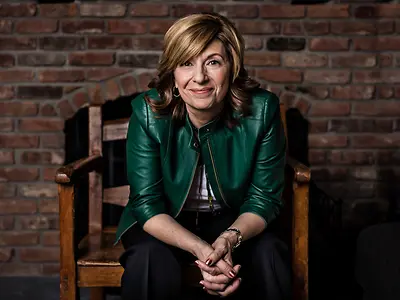
She supports executives and CEOs in their personal development: In this interview, executive coach Pam Manfredo Curtis explains how childhood shapes leadership style.
You've been in this business for decades. Why did you decide to write a book on the origins of leadership now?
After coaching executives for 35 years, I felt that the patterns I had witnessed for so long were not just occurring at the executive level. They happened in my own home, in my friends' homes, in schools and in the community activities I'm a part of. In addition, my third child was about to go off to college, and I wanted to make sure that I had taught her - and her brothers before her - the lessons I had always hoped to teach them.
One of the bold claims in your book is that 80 % of how a person behaves as a leader is a direct result of their childhood. That sounds very deterministic.
I understand why that number can sound high, and I don't mean that childhood explains every part of a person. The childhood home is the first system we live inside. We observe how adults talk or do not talk, how they fight or avoid conflict, how they express love, how they give feedback, how they handle pressure and whether they create safety. We practise those patterns for years. Some we emulate. Some we reject. Some we overcorrect against. Later, in leadership, those same patterns can reappear in how we listen, make decisions, build relationships, handle disagreement, give feedback and use power. Leadership does not begin when you get a title. It begins in the early environments where you first learned how people relate to one another. The exact percentage matters less than the central point: if you ignore childhood, you are ignoring one of the most powerful sources of leadership behaviour.
Pamela Manfredo Curtis
Manfredo Curtis is an executive coach and the founder and president of Manfredo Curtis Associates, LLC. In her work with C-level leaders around the world, she draws upon her own emotional intelligence and expertise in industrial and organisational psychology. She is the author of "The Origin of a Leader: Transforming Family Patterns into Leadership Power" (Simon & Schuster, 2026).
Let's assume I am a leader and I want to change …
I wouldn't be in this field if I didn't think people could change. The biggest changes happen between 35 and 55 because adults at that age are willing to learn from their failures as well as their successes. When you're younger, you are trying to prove yourself and show your competence. When you're older, you're not as worried about others' perceptions of you. Change starts with examining your childhood, your personality traits and your values. You always start with self-examination and can gather feedback from other people later to see how they experience you.
It's hard to give feedback because people are afraid to harm the relationship.
What's the best way to gather feedback, apart from listening?
It's hard to give feedback because people are afraid to harm the relationship. So they don't speak their truth. What they don't realise is that a relationship gets better when you give feedback, whether it's positive or negative. There is a four-step process for giving feedback:
Step one is to set the context, to share your positive intentions.
Next you say specifically what you have witnessed, avoiding generic labels.
Step three consists of saying how it made you feel and why. That feeling is the hook that's going to make the other person want to change their behaviour.
Step four is a suggestion for how they might want to do it differently - and an offer to brainstorm that together.
How do I start that journey of self-examination?
By building an emotional timeline. Take a blank piece of paper and draw a line in the middle of the page from left to right - from when you were born to how old you are now. The straight line is emotionally neutral, like zero. I would then ask you to plot events relative to the line according to whether they evoke positive or negative emotions, and give them an emotional weight. Think of getting married or having your first child - those might would be an inch or two above the line. Losing a job might be an inch below the line. If you lost your parents, that would be two inches below. As you draw the key events in your life, you will be able to identify some patterns.
Reflecting on your own leadership style: An emotional timeline of your own life helps you to recognise patterns and influences.
How often do you encounter resistance to this kind of honest introspection?
It is normal to question the process. Most of the people who come to me are very willing to do this kind of self-examination. They are typically being considered for CEO or C-level positions and would do anything to get the job, or they want to think about who they are as leaders. And yet, there are many sceptics who don't want to tell me personal things about their childhood. I tell them to consider the possibility that there might be something to learn. The more involved people get in the work, the deeper they want to go.
Children in wealthy families often grow up in the shadows of a legendary figure, be it a founder or powerful leader. How can they differentiate themselves without breaking with the family legacy?
I've met many people, not just affluent ones, who have been in the shadows of their famous mother or father. They have to figure out who they are versus who their parents are, because for so long, they have been asked to show up to make this other person appear stronger, more capable or competent. They do things in service of this person, and may be happy to do so if they love them. And they are typically very attuned to how other people are responding to this person. But they sometimes forget themselves. A strength that can emerge from this environment is becoming what I call an "illuminator" - somebody who can differentiate themselves from their parent and knows what that requires of them. A parent, for example, may value success and being famous, yet the child may value compassion for others and philanthropy - doing things for others, so they put themselves second. It's not easy to recognise that you have the right to be your own unique person, but when it happens, you want to do that for other people around you.
You say we should treat emotions as data. Isn't that a contradiction in terms?
When we think of a business, we're always thinking in terms of profit and loss, so I think of emotions as the P&L of people. Our emotions give us information. They tell us what mattered, what hurt, what energised us, what frightened us and what still has power over us. When I ask a leader to revisit their emotional timeline, I am watching not only what they say, but how they say it - what happens in their body and face. Those emotional reactions are not distractions from leadership. They are clues. They help us understand what created a strength, a value, a wound or a block.
The biggest changes happen between 35 and 55 because adults at that age are willing to learn from their failures as well as their successes.
Does this approach change when you are dealing with multinational teams with different cultural backgrounds?
I have done this work with high-performance teams in Asia, Europe, Africa and Latin America. When we worked in China, people told me, "No one's going to share their story." It turns out they just wanted the leader to share first. The issue lies with conflict work - when you deal with different views about business, political and social issues. In India, you have a hierarchical society with different castes, so extra focus on psychological safety is essential. In the UK or Germany, for instance, people are more reserved. They don't always show their emotions through their body language, tone of voice or facial expressions, so you have to alter your approach with different individuals based on the culture. But human beings are human beings, and people want to connect with each other.
Wealthy families, leaders or people with influence and power tend to hop around the world. To what extent does this nomadic life help or hinder a person's ability to become a better leader?
Wealthy people are not the only nomads. Military personnel or other professionals who have to travel the world can be nomads, as can people whose parents move around and who are tossed between homes. You become adept at altering your style to fit into all these different environments, but you want to make sure that you're forming emotional attachments to people.
Related content
Innovation and trends
The future of private banking: The human factor in the age of AI
Artificial intelligence is transforming industries at extraordinary speed, and private banking is no exception. For H.S.H. Prince Max von und zu Liechtenstein, Chairman LGT, this shift opens up powerful opportunities - and raises fundamental questions about the essence of banking and the value...
Investment strategies
Beyond the logo: Luxury's quiet shift from having to belonging
Luxury is quietly redrawing its own definition. For the wealthy consumers, status no longer hangs in a wardrobe or sits in a garage - it is lived, felt and increasingly impossible to replicate.
Wealth and purpose
Investing in art?
Is art the most beautiful form of investment? Yes - but only if it genuinely brings you joy. It should never be bought purely for financial reasons, says Jennifer Greenland-Pessina, Art Advisory Specialist at LGT. She explains what collectors should consider - from appraisals and provenance to...
Innovation and trends
More data, less trust: why the human factor is making a comeback
We know more about each other than ever before - and trust each other less than ever. In this interview, AI researcher and marketing professor Peter Mathias Fischer explains why.