- Home
-
Private banking
-
LGT career
-
Market view and Insights

Geopolitics can no longer be neatly separated from the behaviour of markets. In the coming decades, the shape of strategic frontiers will dictate everything from supply chains to capital flows.

The post-Cold War assumption that economics and security could be neatly separated has collapsed. It is simply no longer possible that markets will integrate while politics recede. The IMF's April 2026 World Economic Outlook, "Global Economy in the Shadow of War", has revised global growth to 3.1 %, with downside risks dominating. The Bank of England's 2026 H1 Systemic Risk Survey records geopolitical risk as the top-cited risk to UK financial stability by 95 % of respondents - the highest reading in the survey's history.

Just think about how intertwined politics is with major economic forces. Orbit, energy, data, critical minerals, semiconductors and biotechnology are no longer adjacent, subsidiary concerns managed on the sidelines by specialists. They are the major axes along which the next decades of geo-economic rivalry will be plotted.
For the last three decades, the dominant assumption in Western capital markets was that the state would retreat from economic life. That era is over. Consider the space race. Once again nations, not just companies, are competing to dominate the future nascent space economy. And when it comes to critical minerals, Western governments are deploying strategic reserves, guaranteed minimum prices and direct equity participation - tools that resemble Cold War-era industrial planning more than 21st century market liberalism.
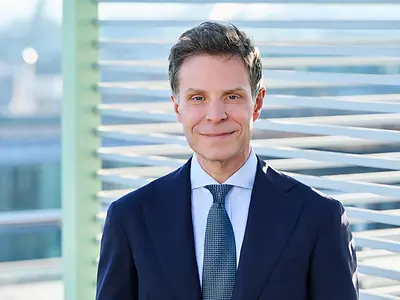
Dr Mika Kastenholz is the Global Head Investment Solutions at LGT Private Banking. With an academic background in science and technology, Mika Kastenholz has more than 20 years' experience in capital markets, trading, and investment products including cross-asset derivatives. He is the author of a book on derivatives trading and also co-founded a fintech firm specialised in private banking and wealthtech solutions.
Artificial intelligence (AI) links both axes here. Export controls on gallium and germanium now reach into the semiconductor and AI hardware supply chains. In space, overlap between dominant companies, SpaceX and xAI, is embedding frontier AI into the same strategic infrastructure as orbital communications, necessary for operations.
These shifts are structural, not cyclical. Government policy and statecraft have returned as primary forces in markets; states are customers, financiers, regulators and increasingly, shareholders. Sectors with sustained policy support enjoy a tailwind that traditional cash flow models may systematically underestimate.

The US and Chinese economies remain deeply intertwined in trade, finance and technology, even as politics become more important. It's not a decoupling, but we are seeing a selective bifurcation along strategic lines.
Orbital infrastructure, rare earth processing, advanced semiconductors, AI compute and biotechnology are being deliberately separated. Consumer goods and conventional manufacturing largely are not. The map of global commerce is acquiring a strategic overlay that is determining which flows are encouraged, tolerated or restricted.
Rarely has the geopolitical importance of raw materials been as high as it is today. Within just a few decades, China has become the dominant power in rare earth and other critical minerals. These unobtrusive building blocks are necessary for all sorts of now critical parts of modern life - electrification, wind power, AI data centres, space projects and in future, humanoid robots, just to name a few.
The US is somewhat on the back foot when it comes to facing an integrated and highly optimised Chinese mineral value chain, which runs from exploration through separation and refining to the manufacture of high-performance magnets. The US is responding by building strategic reserves, forming new alliances and pursuing aggressive industrial policies, from subsidies and offtake agreements to guaranteed minimum prices, while also relying more heavily on recycling to regain lost ground.
The aim is not so much to decouple from China. Rather the US seeks to mitigate economic and strategic dependencies and make them harder to use as political leverage. Success isn't guaranteed here. Secure access to critical raw materials is becoming, alongside data, chips and energy, a decisive factor shaping the global balance of power between rivals, China and the US.
This selective bifurcation creates investment opportunities. Companies positioned on the favoured side of strategic boundaries gain access to subsidies, captive demand and often protected market positions. Those caught on the wrong side face export controls and forced restructuring.
The most prominent examples are CHIPS Act beneficiaries on one side and firms whose accessible markets have been narrowed by US semiconductor export controls on the other. Geographical diversification, once considered a simple risk-mitigation tool for both investors and companies, now requires a layer of strategic analysis that few traditional analytic frameworks embed.

Within this new geometry of power, AI has become a dominant accelerant. It sits at the centre of strategic competition - the rationale behind US export controls on advanced semiconductors, the demand driver behind the critical minerals contest, and a principal cause of the energy infrastructure squeeze reshaping power markets globally. For long term portfolios, the implication is that AI exposure is not a thematic, strategic trade requiring nuanced timing. Rather AI has become a structural component of overall asset allocation. It's not about whether to own AI, but how to weight the exposure across the stack. Each layer - compute and semiconductors, data centre infrastructure and power, hyperscale platforms, foundation models and applications - carries different competitive dynamics and different sensitivity to the circular financing dynamics the IMF has flagged as a systemic amplification channel.
Far from being a technology trend, AI is driving a global infrastructure build-out.
Importantly, this new geometry is not only restrictive. It is also expansionary, and the capital-market coordinate is equally important. Strategic bottlenecks are not emerging in a vacuum; they are being financed by companies whose earnings power remains unusually strong. In the current US reporting season, 84 % of S&P 500 companies have beaten EPS expectations and 80 % have beaten revenue expectations, while blended earnings growth is running at 27.7 %. The AI build-out adds a second force: capex estimates of roughly USD 765 billion in 2026 are turning compute, semiconductors, data centres and power supply into a single investment system.
This is why AI exposure should not be treated only as a technology trade. It is becoming a capital-intensive infrastructure cycle at the intersection of corporate cash flow, state policy and strategic scarcity. Today, the clearest expression of these exposures remains at the physical, picks-and-shovels layer - the silicon, networking and cooling infrastructure on which the entire ecosystem depends. Here, cash flows are visible, dollar-denominated and largely indifferent to which specific model or platform ultimately wins. As economic value emerges further up the stack, allocations can rotate accordingly. The discipline is exposure across the full stack, weighted by where economic value is currently most clearly expressed.
For investors, some new principles are emerging. First, diversification must now include strategic diversification - balance across the geopolitical blocs reshaping capital flows and along the value chains they are restructuring.
Second, the boundary between thematic and policy driven investing has dissolved; understanding government priorities is just as necessary as identifying opportunities.
Finally, conviction matters more than ever. When state action is deliberate and sustained, opportunities tend to compound for those investors who position themselves early and hold through the volatility that strategic competition inevitably produces.
The new geometry of power is being drawn in real time. If the event horizon describes the threshold we are crossing, this geometry describes the landscape on the other side - curved, contested, and coordinated by gravitational forces that no investor can afford to ignore.
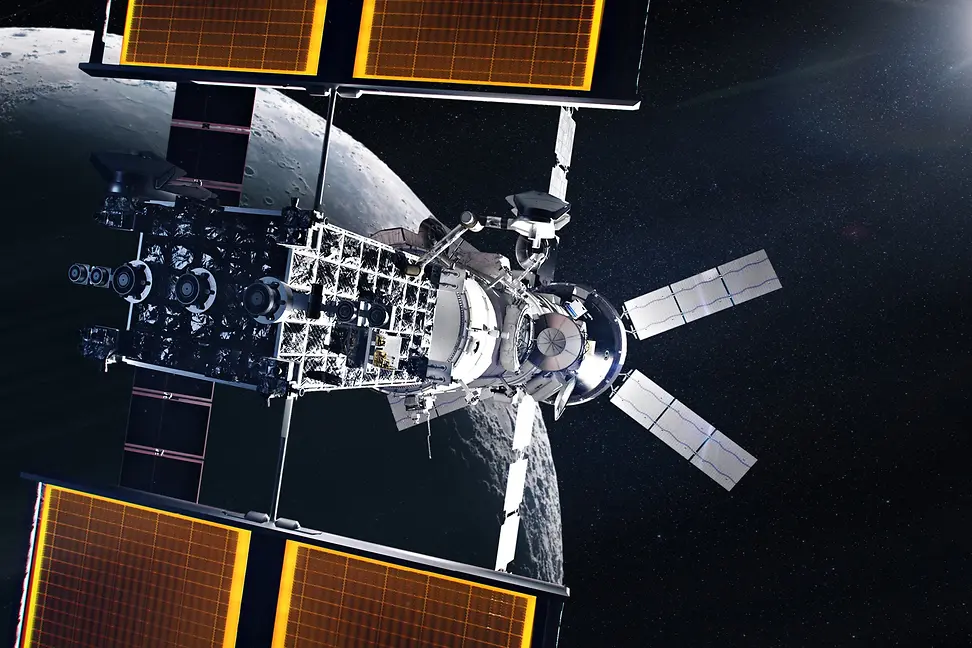
Seventy years ago, the space race was a proxy war fought in orbit. A contest of ideology and engineering prowess. Today that rivalry has returned but it looks a bit different. Yes, the US and China have both set their sights on crewed lunar landings, with NASA's Artemis programme targeting 2028 and China aiming to land before 2030. But the potential successes will rely on the involvement of private companies. SpaceX's reusable rockets have significantly reduced the cost of reaching orbit, enabling a nascent space economy. SpaceX's Starlink constellation already consists of over 10,000 satellites, and the company has announced its IPO. The new space economy promises to address terrestrial challenges while also offering new opportunities, such as space-based data centres. While the first space race ended with flags and footprints, this one involves establishing permanent bases on the Moon and opportunities for private companies.