- Home
-
Private banking
-
LGT career

Historically, uncertainty around these pivotal contests has tended to subdue stock returns in the runup to midterm elections, although performance often improves once the results are known.

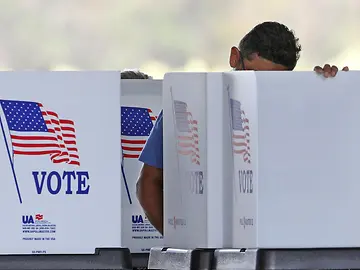
On 3 November 2026, all the members of the US House of Representatives and one-third of the Senate will stand for re-election. Given President Donald Trump's eventful second term in office, these midterm elections are a focus not just for politicians, but for investors as well.
These elections hold the key to future Congressional power. Today, Republicans hold control of both chambers, although the House margin is exceedingly slim. Should that change - or even if it doesn't - the elections will determine how easily Trump can deliver his agenda.
According to data compiled by Inside Elections, a nonpartisan newsletter that analyses congressional races, Democrats need to gain just three seats in the House of Representatives to retake control of the chamber, where Republicans currently hold a narrow majority. Where the balance of power will land in the Senate is a bit more uncertain. At LGT, we believe that either a split Congress (Democratic House, Republican Senate, for instance) or a Democratic Congress are the most likely outcomes.
Whatever the outcome, the next few months are likely to show subdued US stock market returns. Historical analysis clearly shows that the median return for the S&P500 in a midterm election year is just half that of other years. The reason for this is that political uncertainty, polarisation, and general tension tend to intensify in the run-up to such elections.

The pattern is particularly striking if we compare the periods from one year before to one year after the midterm elections. On average, the US equity market achieved its strongest performance in the 12 months following the midterms. Once the election results are known, political uncertainty subsides and investors refocus more strongly on fundamentals.
So it's important to remember that this is a short-term effect, which while observable, should not trouble long-term investors. Rather than react to the current uncertainties, investors with a long investment time horizon can use the midterms as a marker, and simply reassess when the outcome is known.
Market volatility in the period leading up to the midterms demonstrates investors' concerns over political and economic uncertainty, particularly in the three months leading up to the elections. Historically, October has been the most volatile month.

What is relevant for investors to consider is the pattern frequently observed before and after major elections in the US: in the run-up, traditionally more defensive sectors, such as consumer staples, healthcare, IT, communication services, and real estate have historically often demonstrated relative strength. Once the dust has settled, the more cyclical sectors of the market, like industrials, materials, and consumer discretionary, tend to perform better. To be sure, any investment including in equities carry the risk of loss.
Looking at the US equity market following midterms in the context of the composition of Congress, the following picture emerges: Historically, the performance of the S&P500 has been particularly strong during periods when Congress has been controlled by the Republicans. Markets often associate Republican majorities with deregulation, business-friendly tax policies, and high defence spending. In other words, with conditions that have traditionally been considered particularly supportive for equities.
Finally, however interesting it is to consider the impact of the midterms on investment activity, the significance of this area of politics usually pales in comparison to key drivers like economic growth, corporate profits, inflation, interest-rate trends, and technological progress. Nevertheless, political decisions and the shift in balance of power than often ensues can alter the operating environment for individual sectors, due to changes in regulation, government spending programmes, or tax incentives. Against this backdrop, investors may benefit from identifying companies that are well positioned under different election scenarios.