Entrepreneurship

"I am proud of what IT has delivered for humanity"

Tech entrepreneur Bob Goodson came up with the like button that powers today's web. He tells Insights why studying liberal arts can be the foundation for a successful career and why humans are hardwired to give and seek approval.

  • da Steffan Heuer, guest author
  • Data
  • Tempo di lettura 5 minuto

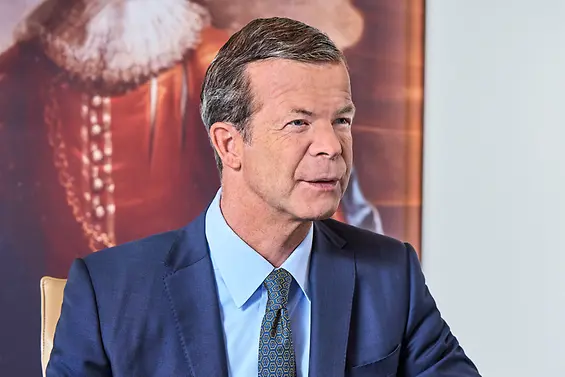
Bob Goodson, Founder and President of Quid, Silicon Valley, USA
From philosophy student to innovation pioneer - how this career helped shape the modern internet.. © Denisa Ilie, for Harvard Business Publishing, 2025

Summary

  • How a philosophy-and-literature student from Oxford became a tech pioneer shaping the modern web.
  • The psychology behind the Like button: why our brains reward both giving and receiving approval.
  • Social media's double edge: from soaring engagement to addiction risks and the need for better safeguards.
  • What's next after buttons? A future where thoughts, not clicks, signal what we like.

How did studying philosophy and medieval literature at Oxford prepare you for a career in tech ? 

Bob Goodson: There are two things I've been fascinated with since I was eight years old. One is programming and the fact that we can teach computers to do stuff for us. When I was going into university, I didn't see a future in that from a career standpoint. For me, it was always a hobby. My other big fascination has been language. The power of words to shape how we think, to me, seems like the ultimate frame. Which is why I studied philosophy and literature. I wanted to be a professor in literature and philosophy.

Things changed when you met the founders of PayPal in 2003. You decided to move to San Francisco to work at a new company called Yelp.

Oxford Union the famous debating society in the historic city of Oxford.
Oxford deepened what had driven him all along: how words shape thinking - and technology. © Chris Harris/Loop Images/laif

Suddenly I was predominantly working as a front-end programmer and user interface designer. I was doing my hobby as a profession, but my interest in language was always there. What I loved about Yelp is that we were collecting all these words from people, reviews of local businesses. We were collecting millions of these and really not able to do much with the sentences themselves beyond basic analytics. That brought me back to my interest in language, and that's where Quid came from. We've been analysing large language data sets since 2013, which brought my two interests together. And now look at Gen AI - the focus on language is suddenly the most interesting thing happening in tech.

Looking at today's tech landscape, is that path still an option for somebody with a liberal arts background?

I do think it’s still the case. Reid Hoffman, the founder of LinkedIn, studied philosophy at Oxford for two years and has a liberal arts background. He once said to me that entrepreneurship is the last great apprenticeship career, which is an interesting phrase. In the Middle Ages, we had apprenticeship careers in everything. If you wanted to make barrels or something, you had to study with a master for years. We like to think of entrepreneurs as these people that just go and figure it all out. And that does happen. But most people start by working for an amazing manager, leader or another entrepreneur and learn the trade.

Let's talk about the like button. You sketched the idea on a piece of paper in May 2005. Does that make you the father of the like button? 

I don't want to make that claim, because it goes against the way I think about invention and innovation. Various people made significant contributions at different milestones. At Yelp, we were the first to put multiple emotions on a piece of web content and, perhaps more importantly, we were the first to let you react and stay on the page. We put those buttons on the website just a week or so after I did those sketches. One of the ideas I put down was the word "like" and a thumbs up as one of the options, which no one really put together for several more years.

A simple sketch on a notepad - and a single thumb goes on to change the digital world. © Bob Goodson

Why does this thumbs up button resonate so well with humans?

There are two major factors. One is the dopamine release that's triggered by giving a like and also receiving a like for your content. The dopamine cycle has two important moments. One is when you imagine what it's going to feel like to get the thing you want, and the other is when you actually receive it. While you're uploading a photo or a post, you're thinking about the likes you're going to get, which gives you a little buzz. When people start liking it, you're getting another dopamine hit.

What's the second biological hook the button exploits?

We are conditioned for intense social learning. We gravitate to be around people like ourselves, and ideally, people who are slightly ahead of us in some way. Liking is a way of us acknowledging the people we admire and are learning from.

There is a lot of money involved. Why is clicking on a thumbs up icon so valuable?

There are around 50 billion likes happening every day. Think of the billions of dollars a year it costs to store that data, so there has to be a real benefit for sites. It serves as a sort of rocket fuel for social media because it creates higher engagement. Brands absolutely love it, because there is no better evidence than likes that your advert is working.

We are wired to give and seek approval

What are the biggest downsides of having this little widget pop everywhere?

It's connected to the addictive nature of social media which is a big topic of conversation. How do you regulate the addictive nature of it, and how do you provide the regulatory framework for protecting younger people? Adolescence is a very sensitive developmental phase when you’re finding out who you are in relation to your peers, so how do you make sure it doesn't have negative consequences? There's a lot of work to be done around these questions. 

It's been 20 years since you drew your little sketch. Do you sometimes wonder if you played a role in weaponizing social media?

First of all, I don't know what weaponizing social media means. The way things get developed is more like an evolutionary process. It's very ego-driven to think that you really make that much of a difference when you're an individual developer. Take the biggest figures in tech right now - people like Elon Musk, Satya Nadella, Tim Cook - who are making these massive decisions. We should think about them as midwives, overseeing the birth of something that they don't have much control of at all.

Silicon Valley - the epicentre of digital transformation - Goodson's second home. © unsplash/Nils Huenerfuerst

Are you happy with how your " baby"  has developed? 

Well, I don't think it's my baby. The like button is something that has evolved. Am I proud of what information technology has delivered for humanity in the last 20 years? I think people involved in it should be proud. History will bear that out as a really important stage of human development, as an important stage of creativity. I grew up in a household where we couldn't really afford books, and I loved reading. We've just made encyclopaedias free for every child in the world who can access a phone or laptop, which I realise isn't completely free, but they can walk into any library, they can pick up any device and can access all the world's information. The contribution to convenience and to knowledge sharing has been absolutely enormous, and that's why I continue to work in tech.

We're moving from touch screens to a new world with virtual reality glasses, even brain-computer interfaces (BCI). How will we give approval in the future?

It's clear that we can communicate with machines via thought. We have people now who can interact with computing in very nuanced ways with chips or sensors on their brain. I don't know the time frame, but it's inevitable that we're going to have a seamless connection to compute through thought. Machines will know what we like, with some controls as to what we do and don't reveal about our thoughts. 

Book

Martin Reeves, Bob Goodson: Like: The Button That Changed the World (Harvard Business Review Press, 2025)

Person

Bob Goodson, Founder and President of Quid, Silicon Valley, USA
Bob Goodson, Founder and President of Quid, Silicon Valley, USA © Denisa Ilie, for Harvard Business Publishing, 2025

After poring over 15th-century poetry at Oxford, Bob Goodson moved to Silicon Valley in 2003 to become the first employee at the review platform Yelp. He went on to found data analytics firm Quid, whose AI models are used by many Fortune 50 companies.


A young Caucasian man with a dark beard is standing on a rooftop terrasse fronting the camera.
Entrepreneurship

GenAI at LGT: "We will evolve together"

As Head of Data and Innovation, Simon Gomez is responsible for generative artificial intelligence (GAI) at LGT Private Banking. In this interview, he talks about the benefits and limitations of GAI, and why humans (and our faith in them) remain a top priority at LGT.
C3PO, r2d2, Star Wars
Entrepreneurship

When brawn meets brain

From factory floors to homes, the race is on to endow robots with the smarts of artificial intelligence.
A black and white scene from the movie Metropolis shows a woman's head wearing a helmet with wires attached.
Entrepreneurship

Artificial intelligence and the art of imitation

The evolution of AI - humankind's attempt to artificially imitate its own intelligence.
Dr Anne-Laure Le Cunff, founder and neuroscientist, Ness Labs and Institute of Psychiatry, Psychology & Neuroscience, King’s Collage London
Entrepreneurship

A practical guide to making the most of your life

Pursuing a goal-obsessed career is a waste of precious time, says tech entrepreneur-turned-neuroscientist Anne-Laure Le Cunff. In her bestselling book "Tiny Experiments: How to Live Freely in a Goal-Obsessed World," she recommends stepping off the treadmill and embracing uncertainty.
Demis Hassabis giving a speech
Entrepreneurship

Demis Hassabis: AI entrepreneur, tech titan, polymath

British DeepMind founder and CEO Demis Hassabis remains a humble figure in the world of brash tech giants.
Colourful lights on a large official building in classical style. In the foreground you can see dark silhouettes of many people.
Entrepreneurship

Global hotbeds of innovation

Silicon Valley isn’t the world’s only centre of technology and innovation. We take a look at six growing tech hubs around the globe and what makes them attractive for founders and start-ups.