- Home
-
Private banking
-
LGT career
-
Market view and Insights

The growing use of renewable energy sources poses additional challenges for electrical grids already struggling to cope with increasing demands for power. Batteries are the missing piece that can help ensure a modern and flexible energy system.
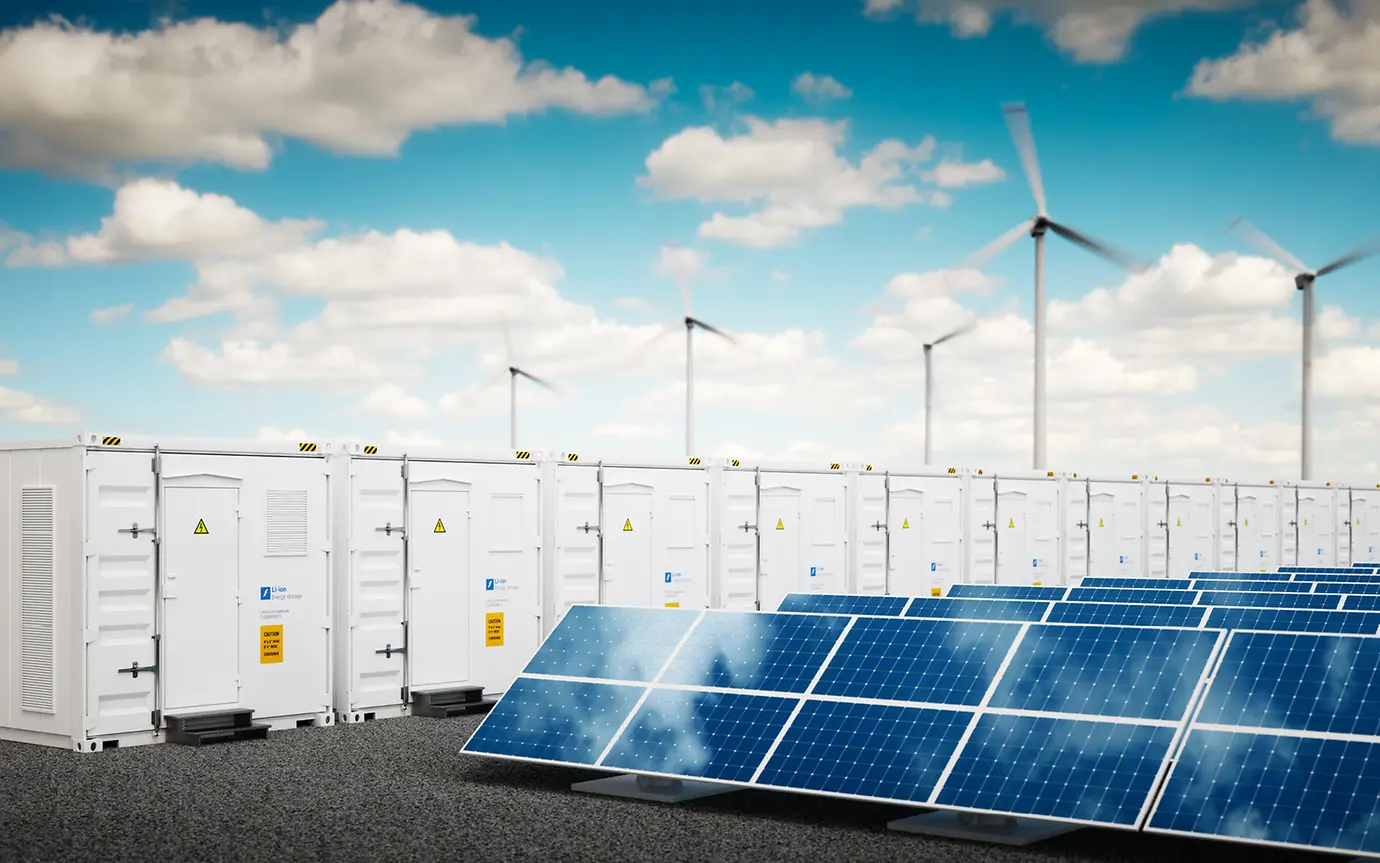
Reducing the proportion of fossil fuels used for energy production is critical for tackling the climate crisis. This can only be done by accelerating the growth of renewable energy sources. At the COP28 climate summit in Dubai, heads of state and governments agreed to triple the global capacity of renewable energy by 2030, in an attempt to meet the 1.5 °C Paris Agreement target.
But the growing use of renewable energy sources presents challenges for the electricity grid, especially as energy is now being generated in more decentralised ways. Offshore wind plants and fields of solar panels provide a very different model of energy production than traditional centralised power plants. And of course, many consumers have become producers as well, generating electricity on-site and feeding surplus power into the public grid. This turns the grid into a two-way system, rather than a one-way supply chain.
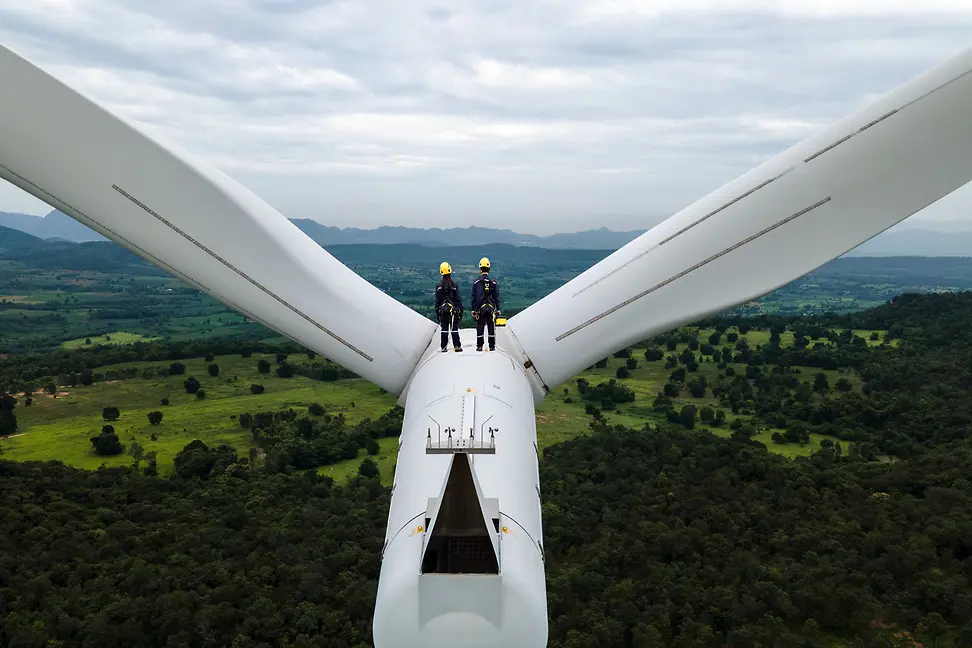
According to Ember, an energy think tank, while 40 % of global electricity generation already came from low-carbon sources in 2024, this share is likely to grow. In the first half of 2025, solar- and wind-generated power exceeded coal-fired power for the first time - a critical milestone.
With new solar and wind projects constantly coming online, it's vital to expand and modernise the electricity grid and keep it running optimally, so it can handle peak loads and prevent energy bottlenecks. This means ensuring the grid can cope both when renewables don't produce enough power - as well as when they produce too much.
Battery storage is a balancing act: energy, safety, cost.
That, in turn, requires solutions that balance shortages and surpluses of renewable power over time - where energy storage solutions come in. Simply put, this means batteries, which can store surplus renewable energy when it's produced, typically around midday, and instantly release it when supply is scarce, typically in the early morning and evening hours.
Today, battery storage is primarily integrated into the grid to cushion short-term peak loads; it operates for between one and eight hours. So far, battery storage systems have been regulated by the electricity market. This means that the systems are charged when electricity is cheap - when the sun shines, for example - and discharged when prices are high during periods of peak demand.
Of course, batteries aren't the only choice: pumped water storage power plants and (green) hydrogen will also be part of the energy storage story. But it's batteries that offer the most potential for investors today.
With improved regulation and financial incentives, battery storage systems could respond to load bottlenecks or grid fluctuations, and act as reserve capacity. To further relieve the grid, battery storage could be installed at critical grid nodes, or directly next to solar parks, wind farms, and data centres. This would stabilise the grid and make grid expansion cheaper overall.
Battery technology is developing rapidly. Competition among manufacturers is intense, as they seek ways to improve battery cell chemistry and design. The battery cell is the smallest storage unit. A variety of designs aim to balance three important parameters: energy density, safety, and price.

Cedric Baur is an equity specialist at LGT specializing in sustainability, responsible for topics such as climate change, renewable energies, energy infrastructure, water, and the circular economy. His focus is on companies in the energy, utilities, industrial, and basic materials sectors.
The most common rechargeable battery type is the lithium-ion battery, familiar from its use in smartphones. Battery development was mainly driven by the EV market, where two types dominate: lithium nickel manganese cobalt oxide (NMC) and lithium iron phosphate (LFP). NMC has long been the preferred option because of its high energy density, although ethical concerns about cobalt mining have moved the market towards a NMC version that contains less cobalt.
LFP batteries, on the other hand, dominate the storage market. These batteries are cheaper than NMC, have a longer service life and better thermal stability. Depending on the price of lithium (lithium carbonate), manufacturers are further improving the cost profile for LFP, taking into account learning effects in cumulative production volume and advancements in cell chemistry. The energy research firm BloombergNEF suggests that LFP batteries will dominate the battery storage market until at least 2035.
That said, sodium-ion batteries are emerging as a potential alternative to lithium cells. Fewer critical materials are needed to build these batteries, and the requirements for water and land use for extraction are lower than for lithium. However, the energy density of these batteries still lags behind other cell chemistries.
Falling prices mean that battery storage systems are becoming increasingly attractive for both homes and larger utilities. Globally, storage capacity within utilities is expected to increase by 23 % in 2025 and 33 % in 2026. This growth is being driven by countries like China and the USA, as well as markets including Germany, the UK, Australia, Canada, and Saudi Arabia. As a result, this sector is well worth considering as an investment.
Dunkelflaute is an onomatopoetic German word that can be translated as "dark doldrums". This phenomenon occurs when little or no energy can be generated through solar and wind power. For the power grid, this is a problem. Fossil fuel generation produces steady and reliable electricity; renewable energy sources like solar and wind deliver variable outputs, for obvious reasons.
Battery storage helps grid operators to accommodate the fluctuations in power generation from renewable energy sources. But it doesn't solve the entire problem. According to Germany's Fraunhofer Institute, Dunkelflaute occurred three times during the last year, meaning that wind and solar power accounted for ten per cent or less of electricity generation for two consecutive days. While battery storage can absorb some demand during these periods, gas-fired plants often have to step in.
If Dunkelflaute events increase, the problem could become more severe. What could help in the long term would be the conversion of those reserve or back-up gas-fired plants to hydrogen. This could help to store renewable energy that is generated at peak times for longer periods.
The German electricity market is part of the wider European market, meaning that electricity is traded across borders. Increasing battery storage capacity and improving grid integration should have a stabilising effect overall, reducing the need for reserve power plants, and leading to falling electricity prices.
Batteries don't last forever and once again, technology is stepping in to help. As electric vehicle use has increased, so too has the issue of what to do with the batteries when they reach the end of their service life. Current recycling capacity is limited, and most of it is located in China, although several plants are set to be built in the US and Europe.
While most recycling activity focuses on preventing toxic chemicals or heavy metals from leaching into the environment, it turns out that some older electric vehicle batteries can be reused in stationary storage systems, extending the batteries' service life.
It's also becoming increasingly lucrative to reuse materials like lithium, cobalt, and nickel, in part to reduce the potential risk of future supply bottlenecks. When electric cars or large-scale storage systems are returned or dismantled, manufacturers have direct access to the materials, which will enable closed supply cycles in the future.
The European Union has already focused on battery recycling, setting targets that include 50 % recovery of lithium from used batteries by 2027, rising to 80 % by the end of 2031. It is also targeting 90 % recovery of cobalt, copper, lead, and nickel by the end of 2027, rising to 95 % by the end of 2031. Industrial batteries also face targets, with new batteries requiring a minimum proportion of recycled content from 2031 onwards.
Alongside traditional financial factors, impact investors take social and environmental aspects into account when managing their portfolios. LGT's partner company Lightrock is one of the pioneers in impact investing: since 2009, Lightrock has been investing in sustainable and fast-growing companies in Africa, Europe, India and Latin America that make a measurable contribution to systemic change.