
- Accueil
-
Private banking
-
Insights et vue du marché

Low-hanging fruit, vibe shift, disruption: Corporate jargon is everywhere. Used well, it can sharpen ideas and foster belonging. Used badly, it clouds meaning and chips away at credibility.

"First, we need to prioritise the low-hanging fruit." - "To make sure we get the quick wins?" - "Absolutely. That way we leverage the ecosystem synergies." - "Shouldn't we talk to the stakeholders first?" - "Yes. Then we scale the programme in a disruptive way."

Welcome to business-speak, a language spoken fluently at companies across the globe. Only the playground churns out new buzzwords and catchphrases faster. But why is that? And what purpose does corporate jargon really serve?
"Consultancies and agencies like to coin new terms to differentiate themselves and appear innovative", says Stefan Häseli, communications consultant and business comedian. That's how acronyms such as VUCA (volatility, uncertainty, complexity, ambiguity) and BANI (brittle, anxious, non-linear, incomprehensible) were born.
"If a word appears often enough in the media, it becomes fashionable. An insider code emerges. Use it, and you signal that you belong to the business elite."

"When people work closely together, language evolves dynamically", says Christa Dürscheid, professor emerita of linguistics at the University of Zurich. "Jargon can strengthen people's sense of belonging. And some words cut straight to the heart of complex issues." At times, naming a problem - burnout, mental load - helps us recognise it. At others, new trends demand fresh vocabulary, such as "new work". In short, jargon can serve many functions.
"Buzzwords are not inherently good or bad. They're like sailing manoeuvres: if they're executed well, they set the course; if misused, they can obscure the facts", says Christiane Brandes-Visbeck, Managing Director of AHOI Innovationen GmbH and author of "HR Storytelling". Effective leaders don't rely on empty catchphrases, she explains, they tell stories that make the company’s direction tangible.

"I personally like the term vibe shift", says Brandes-Visbeck. Borrowed from pop culture, it describes a change in trend - something that business is sorely in need of, she argues. "It's a pity that in a corporate context, the term is increasingly used to signal a return to more restrictive norms."
Brandes-Visbeck likes to use metaphors - people remember them far longer than abstract concepts. Management guru Peter Drucker (1909-2005) understood this; he coined the term "low-hanging fruit" for problems that can be resolved quickly.
But business jargon can also backfire. Jens Bergmann, deputy editor-in-chief of the German magazine "Brand eins" is fascinated by what he calls "business bullshit" and has written a book on the subject. He believes that opaque communication makes people harder to pin down - and helps them conceal their insecurities. "Bullshit is consensual", he explains, "because nobody bothers to challenge it."
Bergmann identifies six categories of business-speak:
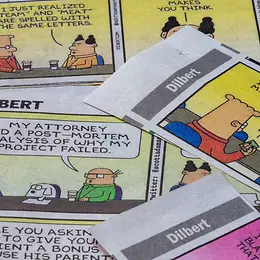
Pacific Bell discovered the dangers of using corporate jargon in 1987, when the telecom giant spent USD 40 million training 70,000 employees in mystical vocabulary such as "alignment" and "intentionality". Meetings grew longer and communication became less effective. One employee, Scott Adams, channelled his frustration into art. His comic strip "Dilbert" remains popular today.
According to André Spicer, organisational psychologist and Dean of Bayes Business School, City University of London, "business bullshit" is rarely about reality. Instead, it is often used to pursue personal or organisational interests. People who speak this way generally want to attract attention and showcase their status. "Bullshitters crave an audience the way artists do", he writes - but at the cost of trust.
In his 1986 essay titled "On Bullshit", American philosopher Harry G. Frankfurt argued that bullshit is defined by its indifference to truth. So what is the antidote? "A bullshit-free zone would be more productive", says Spicer. But achieving that requires people to engage - even with uncomfortable topics - and to foster a genuine dialogue.
"Managers are most effective when they communicate honestly, vividly and relatably", says Brandes-Visbeck. "Images and stories grounded in everyday life not only resonate, they also show respect for the other person."
At the end of the day, management-speak is a modern lingua franca. Those intent on climbing the corporate ladder ignore it at their peril. And who knows, the timely use of a well-placed buzzword might even yield a piece or two of "low-hanging fruit".