- Home
-
Private banking
-
LGT career
-
Market view and Insights

As the Tonhalle-Orchester Zürich returns to Japan, the orchestra's Music Director Paavo Järvi and Yoshitaka Nagakura, Chairman and CEO of LGT Private Banking in Japan, reflect on tradition, audiences, young talent and music's power to build bridges.
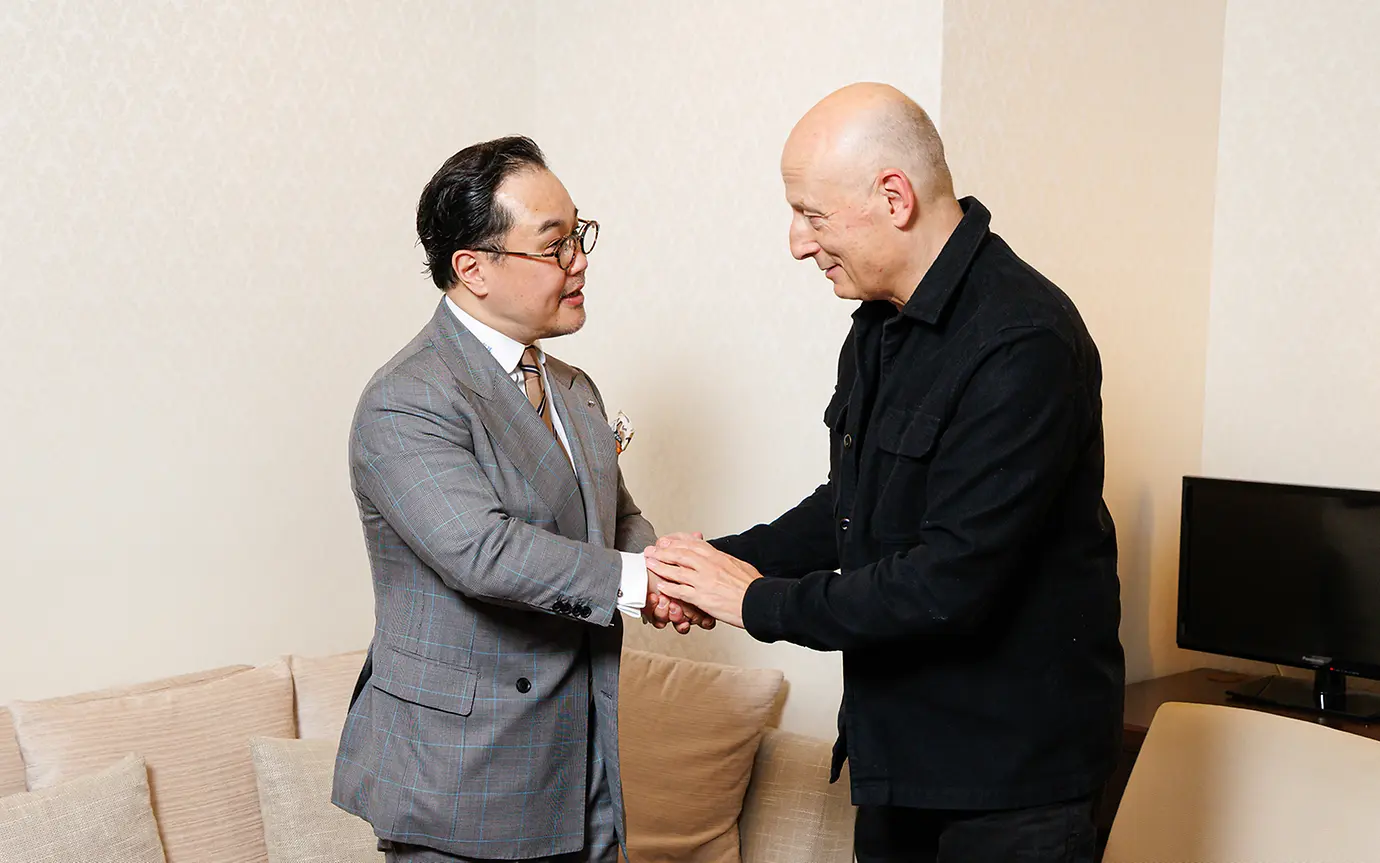
Paavo Järvi: It is always special to come back. My first time conducting in Japan was 30 years ago. It felt like I was entering a completely different world - almost another planet. The food, the traditions, the language, everything was new to me. Later, during my time with the NHK Symphony Orchestra, I gradually began to feel at home here. What has stayed with me ever since is the deep sense of respect that runs through Japanese culture. There is a quality in personal interactions, a kind of attentiveness and dignity. I have always appreciated that very much.
Paavo Järvi: Yes, I think they are. In Japan, the audience's attention is usually very quiet and focused. You sense that people are listening for the music's inner depth - perhaps more than in many other places. Bruckner, for example, can be demanding anywhere: the symphonies are long and require real concentration. In Japan, you feel that audiences are willing to enter that world and stay there. They understand this kind of music in a very profound way.
Paavo Järvi: I think that is very important. Music is never only about performance. It also depends on people who care deeply about culture - who protect it, support it and help pass it on.
For over 150 years, the Tonhalle-Orchester Zürich has been delighting its audiences and is now one of Europe's leading orchestras. Supporting the arts and culture is also a long-standing tradition for the Princely Family of Liechtenstein. As the orchestra's principal sponsor, LGT supports the Tonhalle-Orchester Zürich in its artistic endeavours.
Paavo Järvi: Tradition matters immensely - but it must remain alive. It should not be static. In music, tradition has to be renewed with every performance. Even if we play the same work three evenings in a row, it will be different every time. A concert lives in the moment, in what passes between the musicians, in the atmosphere of the hall, in the audience and in the energy of that particular evening.
Paavo Järvi: Yes. AI can identify the most probable solution based on things that already exist, on what has already been said or done. But music is not about the most probable solution. It is about inspiration, about something alive, about a new experience shared with an audience. It cannot be reduced to probability. Music-making is about intuition, imagination, tension, timing, listening and risk. It unfolds in real time and depends on human presence.
Tradition matters immensely - but it must remain alive. It should not be static.
Paavo Järvi: That is beautifully put. Music can indeed feel architectural - and at the same time deeply emotional and human. Perhaps that is why it reaches people so directly, even across different languages and cultures
Paavo Järvi: Both require structure and leadership. An orchestra needs a conductor to bring together a very complex work and shape its interpretation. Similarly, companies need people who make fundamental decisions. But hierarchy alone is not enough. Communication is essential in both worlds: you have to listen, react, understand people, create trust and move in the same direction. Without that, no structure can hold.
Paavo Järvi: Yes. Teaching is something I enjoy very much. I want to understand what young people need - not in an abstract sense, but as individuals. The truth is that I learn a great deal in the process, perhaps even more than the students do. Working with younger conductors refreshes your principles. It brings you back to the fundamental truths that you sometimes forget over the years, or stop focusing on with the same intensity. It is by no means a one-way process.
Paavo Järvi, born 1962 in Tallinn, Estonia, is one of the leading conductors of our time and works with some of the world's most renowned orchestras. He is Music Director of the Tonhalle-Orchester Zürich, Artistic Director of the Deutsche Kammerphilharmonie Bremen (a role he has held since 2004) as well as founder and Artistic Director of the Estonian Festival Orchestra.
Paavo Järvi: Curiosity. Openness. A genuine connection to the wider world. It is important for young artists to stay in dialogue with Europe and America, and with international developments more broadly. The more global their outlook, the richer their artistic personality becomes. Technical mastery matters, of course, but it is not enough. You need imagination, perspective and the courage to look beyond your immediate surroundings.
Paavo Järvi: I was very grateful. Honouring people for their work is a wonderful gesture. For me, a central part of that work has always been cultural exchange. I have always felt it was part of my mission to introduce the music and culture of Estonia, where I am from, to audiences abroad. It was very important to me, for example, to bring the NHK Symphony Orchestra to Estonia. We performed works from both countries, so it became a true exchange - not only introducing Estonian music in Japan, but bringing Japanese music to audiences in Estonia as well.
Paavo Järvi: Many memories - both musical and personal. A tour always brings musicians incredibly close together. In Japan, we get to perform for a loyal and passionate audience. That enthusiasm is one of the things that makes touring here so special. When an orchestra feels that kind of connection abroad, it returns home with renewed confidence. Those experiences stay with an ensemble for a long time.