
- Home
-
Private banking
- Market view
- Insights
-
LGT career

Sharp market drops are unsettling. But the real damage is often done not by a crash, but by the decisions people make in the heat of the moment. These four principles can help investors keep a cooler head.

It's spring 2000. Cindy is feeling pleased with herself. She has just bought what many are calling the hottest stock in the US: Amazon. "Online retail is the future," says the law student. And for a while, it looks as though she is right. Since its stock market debut in 1997, Amazon's share price has surged, lifted by the internet boom and the euphoria surrounding the Nasdaq.
Then the mood changes.
A few months later, Cindy stares at her screen in disbelief. The Nasdaq is tumbling. The media are declaring the death of the "new economy." Amazon's share price keeps falling - eventually by more than 90 % from its peak. Panicked and unsure what else to do, she sells.
A quarter of a century later, Cindy still regrets her decision. Since its IPO in 1997, Amazon has delivered a return of around 131'700 %. "Selling those shares was the most expensive mistake I ever made," Cindy says. What she did not know at the time was that during the downturn, Jeff Bezos was already working on a much bigger plan: to turn Amazon from an online bookseller into the world's largest marketplace.
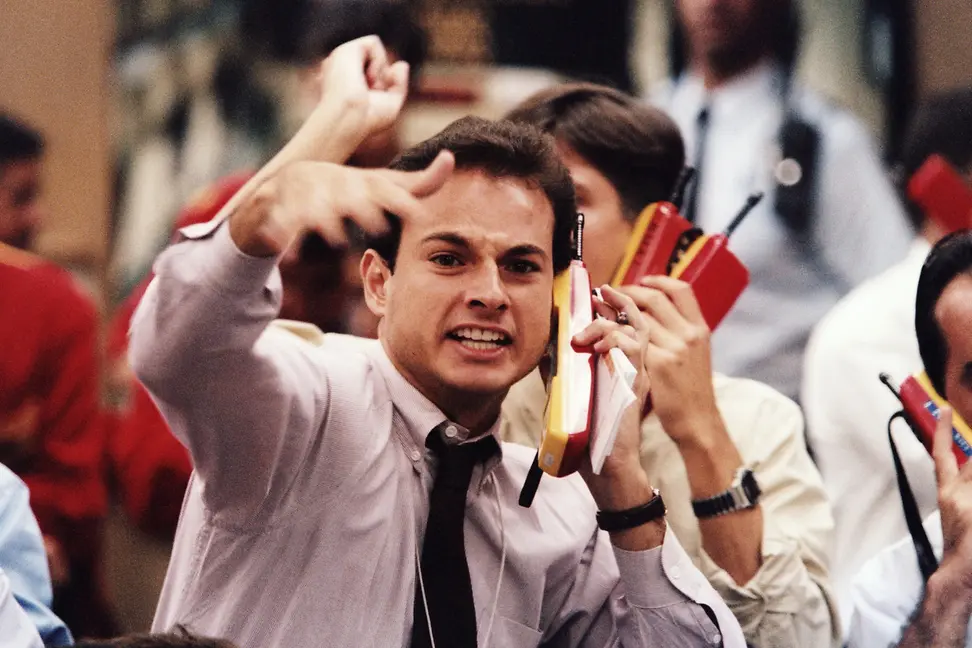
Cindy is fictional, but her mistake is familiar. Market panics are nothing new. Nor is the temptation to sell at exactly the wrong moment. The question is how investors can avoid doing so. The following four principles can help.
Selling in a panic can wipe out the gains made from sensible investing in an instant. This is true not only for individual shares, but also for diversified investments.
Take a simple example: an investor buys an exchange-traded fund (ETF) tracking the MSCI World in the mid-2000s. During the 2008 financial crisis, its value fell by more than half. For anyone watching closely, that would have been hard to stomach. It looks rather different with the benefit of a longer view: over the last 50 years, the MSCI World Index has generated an annual return of 9 %. To capture returns like these, however, investors need to remain invested through the bad times as well as the good - like Warren Buffett.
Buffett explains his approach in simple terms: "Never invest in a business you cannot understand." That makes it easier to stay the course when sentiment shifts. His investment company, Berkshire Hathaway, holds a 9.3 % stake in Coca-Cola. He stuck with it even in the late 1990s, when many investors dismissed the company as boring. Since then, its value has multiplied by a factor of 21.

Coca-Cola is a business Buffett knows very well: he drinks his first can of Cherry Coke at breakfast. But more importantly, he understands how it makes money, how much debt it carries and what its cashflow looks like. Investors who know what they own and why are less likely to lose their nerve when markets turn ugly.
Peter Lynch, the celebrated manager of Fidelity's Magellan Fund, followed much the same approach. Over the 13 years he managed the fund, he achieved an average annual return of 29.2 %. Lynch focused on businesses he understood and backed them with conviction. The result was one of the great long-term investment records.
Amazon's share price has fallen by at least 10 % on more than 50 occasions since it went public. In other words, even one of the market's great success stories has repeatedly tested investors' nerve. At some point, almost every investor experiences that same queasy moment: the portfolio is awash with red, confidence evaporates and selling starts to feel like relief.
Why are people so susceptible to that feeling?

"Many investors are dazzled by stories and hype instead of focusing on quality," says Thorsten Hens, Professor of Financial Economics at the University of Zurich and the Norwegian School of Economics. Nobel Prize-winning economist Robert J. Shiller explored this phenomenon in his book "Narrative Economics: How Stories Go Viral and Drive Major Economic Events".
A company that claims it will change the world will always attract more attention than a steady, profitable business quietly getting on with the job. Shiller sees Bitcoin as a prime example. To this day, the true identity of its founder, Satoshi Nakamoto, remains unknown. It is a reminder of how powerful a narrative can be, even when the fundamental value of an asset is hard to pin down.
Still, the bigger picture is clear: over the long term, shares have been one of the best-performing asset classes. Jeremy Siegel, professor of finance and author of "Stocks for the Long Run", traced 220 years of US market history and found that US equities have delivered an average annual return of 7% after inflation. At that pace, wealth roughly doubles every ten years.
There is an important caveat, though. This only holds for investors who are broadly diversified and prepared to stay invested for the long term - at least a decade. After severe market slumps, such as the Great Depression, a longer horizon may be needed.
Why do shares matter so much in long-term wealth creation? Because buying shares means buying stakes in companies that produce goods and services, invest, innovate and grow. As long as businesses remain productive and competitive, they can continue to create value over time.
"We haven't the faintest idea what the stock market is going to do when it opens on Monday," Warren Buffett once said. It is a useful reminder. Investment success depends less on buying at the right moment than on how long you remain invested. Buffett's preferred holding period is well known: "Forever."
Research suggests that many private investors struggle to accept this. As part of its "Quantitative Analysis of Investor Behaviour Reports", the research firm Dalbar repeatedly found that retail investors lag the market over the long term. One reason is that they overestimate their ability to predict market movements.

A more effective approach is to invest a fixed amount regularly - monthly, for example - rather than waiting for the perfect entry point. When markets are high, that amount buys fewer shares. When prices fall, it buys more. This strategy exploits market volatility rather than fighting it, and over time, it can lead to a more favourable average purchase price. This is known as cost averaging.
The trade-off is that you benefit less when prices rise. But psychologically, that is often easier to live with. Psychologists Daniel Kahneman and Amos Tversky showed that losses hurt about twice as much as equivalent gains please us. This insight shaped prospect theory, for which Kahneman later received the Nobel Prize in Economics.

Terrance Odean, Professor of Finance at the University of California, Berkeley, has spent years studying the mistakes made by retail investors. In one study of 60'000 households, he found that those that traded the most actively achieved the weakest returns. Frequent trading, in other words, tends to come at a cost.
Most investors do not sell because a company's prospects have fundamentally changed, but because they can no longer bear falling prices. So are there no sensible reasons to sell? Yes - there are two.
For Odean, one thing is clear: "Investors shouldn't just know why they are buying a share. They should ask themselves where their judgement could be wrong." How might the competitive landscape change? What impact could artificial intelligence have? How are oil prices, interest rates and the broader economic environment shifting?
Depending on the circumstances, the original assumptions about a company may no longer be realistic. "In that case, it makes sense to sell rather than rely on wishful thinking," says Odean. Sometimes, a more attractive opportunity may emerge elsewhere in the market. In that case, it may make sense to sell one holding and put the money to better use elsewhere.
Life does not always go to plan. Taxes, a property purchase or a business venture may leave investors short of cash and force them to sell securities, rarely at the ideal time.
These are two good reasons to sell shares. Panic selling because everyone else is doing it is not.
Cindy is now a lawyer. There is no stock ticker on her desk, only a framed quote from Warren Buffett - a reminder of the lesson she learned the hard way: "The stock market is a mechanism for transferring money from the impatient to the patient."
Investment styles are as varied and individual as our personalities. Understanding how much time and effort you want to put into managing your money determines much of your investor personality. Find out more about whether portfolio management or investment advice is right for you.